Denver, CO · Ice and the water path
Sub-Zero Ice Maker and Water Line Repair in Denver
One short answer per ice and water question — and a technician who fixes the water path, not just the module. Independent Sub-Zero service across Denver.
- Flat visit fee
- $89
- Someone picks up
- 24/7
- Vans out
- 8:00 am – 8:00 pm, seven days
- What we fix
- Ice and the water path

Gauges on a machine compartment. Very few ice calls end here — far more of them end at a valve screen, a fill tube or a length of line.
Narrow it down
What is the ice actually doing?
Each group below is a fault pattern rather than a part. The questions are the ones asked on the phone most often, answered in one screen with no sign-up and no form.
No ice at all
The bin is empty and nothing is arriving. Start here.
The ice looks wrong
Hollow, cloudy, small, fused or flecked — the shape of a cube says where the fill went wrong.
Filters and cartridges
When the filter is the cause, when it is innocent, and what a stuck one means.
Water where it should not be
Ice on the freezer floor, an overfilling mould, a puddle behind the unit.
The line, the valve and the pressure
Everything between the house plumbing and the back of the cabinet.
Undercounter ice machines
Drains, pumps, descaling and what a machine with an unrefrigerated bin is meant to do.
What we repair
Ice first, then the rest of the cabinet
Ice makers and the water that feeds them are what this shop is for. The other three pages are the rest of a built-in Sub-Zero, and they are here because the same visit usually covers both.
-
01
Ice Maker Repair
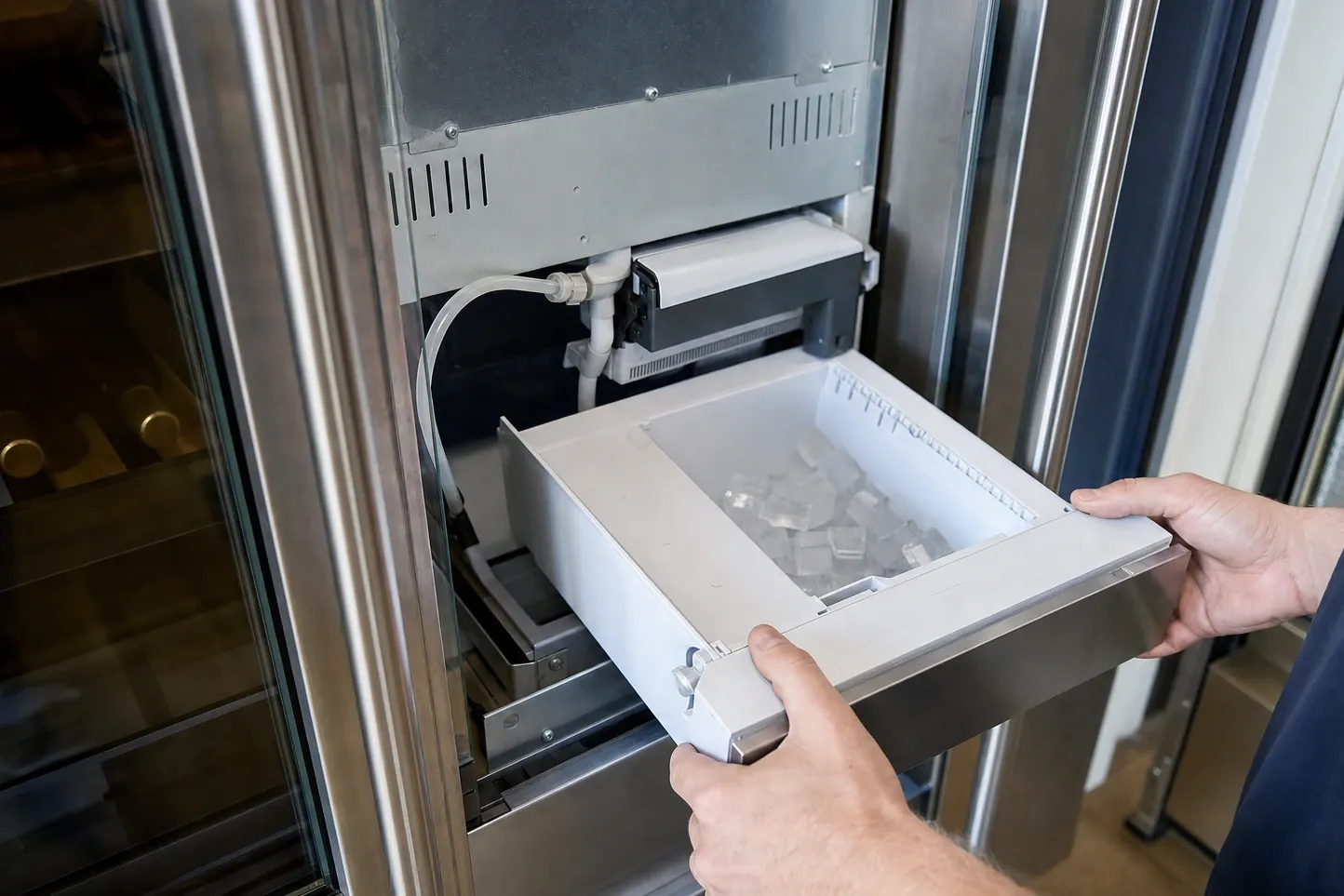
Modules, inlet valves, filters, fill tubes, supply lines, drains and pumps — built-in ice makers and undercounter ice machines.
Called for
- Bin empty for days with everything apparently switched on
- Cubes coming out hollow, thin, cloudy or welded into a block
- Ice carrying a taste that arrived with the last filter
- Undercounter machine standing in its own meltwater
-
02
Refrigerator Repair
Airflow, defrost, dispensers and the fresh-food side of the water path on built-in Sub-Zero refrigerators.
Called for
- Dispenser slowed to a trickle after a filter change
- Meltwater tracking down the back of the fresh-food liner
- Fresh-food section drifting warm while the freezer holds
- Filter light that stays lit whatever is fitted

-
03
Freezer Repair
Frost, drainage and meltwater faults in Sub-Zero freezer sections, drawers and the space under an ice maker.
Called for
- A sheet of ice spreading across the floor under the ice bin
- Drawer dragging or frozen shut on its rails
- Frost returning on the rear panel within a fortnight of clearing it
- Water finding its way out of the cabinet onto the kitchen floor

-
04
Wine Cooler Repair
Zone temperature, seals and condensation in Sub-Zero wine storage columns and undercounter cabinets.
Called for
- One zone reading several degrees off what the shelf is doing
- Condensation beading inside the glass door
- A hum that carries into the room above rather than the kitchen
- Set points lost after a power dip rather than a failure

Book a visit
Say what the ice is doing. We will trace the rest.
$89 flat buys the visit and the whole diagnosis, and comes off the repair when you approve it. Someone picks up 24/7.
Questions
Five questions the phone keeps asking
The short version of five pages in the answers library. Anything not here, ask on the phone — (720) 903-2603.
The ice maker stopped. What is the first thing to check?
The shut-off arm and the bin. An arm resting up, or a bin sitting a finger-width proud of its rails, reads as "bin full" and the machine waits politely for ever. Reseat the bin, drop the arm, then give it a day before deciding anything is broken.
Do you work on the water line, or only the appliance?
Both sides of the compression fitting, up to the shut-off valve. Denver Sub-Zero Repair Experts traces the fill from that valve through the filter, the inlet valve and the fill tube, because a line problem and a module problem look identical from the front of the cabinet.
Why is the ice hollow or half the size it used to be?
The mould is not filling completely. Scale across the inlet valve screen comes first in our experience, house pressure that sags when something else in the building draws water comes second, and a tired valve third. A new filter alone rarely fixes it.
How often does the water filter actually need changing?
Sub-Zero times it by the filter life monitor on the control rather than by the calendar, and on hard water the monitor tends to arrive before you expect it. After a change, run the first full bin of ice into the sink before anyone drinks it.
If I decide against the repair, what have I paid for?
Eighty-nine dollars, flat, and nothing beyond it. You keep the written fault and the part it needs, which is yours to take anywhere you like. Ring (720) 903-2603 and the window is agreed before you put the phone down.
What it costs
Six bands, and the one this shop lives in
Diagnosis is $89, flat: one figure for looking, however long the looking takes. Approve the repair and that $89 is deducted from it.
| Repair band | Typical range | Where it turns up |
|---|---|---|
| Door gasket or seal replacement | $280–$600 | A seal that has gone hard lets humid room air onto a cold surface — which is where a lot of unexplained ice starts. |
| Evaporator or condenser fan motor | $350–$670 | Air, not water. It reaches the ice only because a mould that never gets cold enough never harvests. |
| Defrost heater, thermostat or sensor | $300–$600 | The circuit that keeps meltwater moving. When it stops, the water it should have drained becomes the sheet under the bin. |
| Ice maker, water valve or supply line this site | $300–$820 | The band this site was built around: modules, inlet valves, fill tubes, supply lines, drain pumps and the fittings between them. |
| Electronic control board | $450–$930 | Rare on the water path, and never the first suspect. A board is what is left when the valve, the sensor and the line all measure correctly. |
| Compressor or sealed-system repair | $1,410–$3,070 | A refrigeration fault rather than a water fault. If the readings point here we will say so, and say what it would take. |
What moves the number
- Which end of the path failed. A shut-off arm or a reseated bin is minutes; a module, a valve and a length of line is a fitted part and a proving cycle.
- Whether the fault is on the appliance side of the compression fitting or the house side. We price the appliance side and tell you plainly when the rest is a plumber's.
- Whether the machine is a built-in ice maker or an undercounter ice machine. A machine with its own pump, drain and evaporator has more places to go wrong and more to descale.
- Part availability. Current-series valves, modules and bins are usually stocked locally; some older assemblies have to come in on order.
- Whether it finishes in one visit. If a part has to come in, the return trip is not another service call.
Why this shop
We check the whole tract
An ice maker is the last few inches of a path that starts at a valve in somebody else's cupboard. Four things that follow from taking the whole of it seriously, all four visible on the day.

A condenser matted like this is the commonest reason a cabinet in this city runs all day and still drifts warm. It is a clean, not a compressor.
-
We follow the water, not the symptom
A cube tells you where the fill went wrong. Every visit starts at the shut-off valve and works forward — line, filter, inlet valve, fill tube, mould, bin, drain — instead of starting at the module because the module is what is visible.
-
The fill is measured, not guessed
Output over a timed run, the fill volume, the state of the inlet screen, and the harvest watched end to end. Numbers first; a part is only named once something has been measured out of tolerance.
-
Hard water is treated as the default here
Scale on a mould, a crusted valve screen and a furred circulation pump are the ordinary condition of an ice maker in this city, not an exception. Descaling is part of the visit rather than a line on the invoice.
-
Your cabinetry survives the visit
Columns come forward on their own rails once the toe panel is released, undercounter machines come out on a covered floor, and the line behind them goes back unkinked and checked.
Reviews
Notes from Denver kitchens
LoDo · Central Park · Congress Park · Berkeley
4.9 / 51,156 reviews
Our loft sits over a brick alley and the built-in had crept up to fifty overnight. The condenser turned out to be packed with construction dust from the unit next door. He cleaned it, tested on gauges, and it holds forty again.
Brady K.LoDo
Ice stopped altogether in the middle of a heat wave and the bin smelled sour. He traced it to a dead drain pump, cleaned everything out, and explained how to flush it a couple of times a year.
Georgia W.Berkeley
After a summer outage the wine cabinet came back reading forty on both zones and ignored every button. The control had lost its memory rather than failed. He reloaded it, corrected the set points, and stayed to watch a full cycle.
Colton B.Congress Park
Where we work
Eight places, north and north-west
Loft conversions by the station, bungalows off Tennyson, and the seventies-and-later houses out past the ridge. The water reaches a Sub-Zero differently in each of them, and each page below says how.
- LoDo 80202 Converted brick warehouses and loft kitchens where the built-in is wedged into a tight galley.
- Riverfront Park Union Station towers where the supply comes off a shared riser rather than a tap under the sink.
- Central Park 80238 Newer open-plan houses with butler pantries and paired refrigerator and freezer columns.
- Congress Park 80206 Nineteen-twenties bungalows and Denver Squares, remodelled kitchens with very little clearance.
- Berkeley 80212 Tennyson Street bungalows and new half-duplexes, most with integrated refrigeration and wine storage.
- Wheat Ridge Post-war bungalows and ranches, most of them still fed through a stub of old copper.
- Arvada Seventies to nineties houses with the run through the basement and a softener in line.
- Westminster Suburban kitchens on a different utility again, and a long reach from the shut-off to the cabinet.
How a call runs
Three steps, and you approve the middle one
Nothing is ordered, fitted or charged for beyond the service call until you have heard the fault and the figure.
-
01
Say what the ice is doing
Empty bin, hollow cubes, a taste, a puddle — and the model number from the frame inside the fresh-food door. Those two things decide whether a valve, a module or a bin rides along on the first visit.
-
02
The path is traced end to end
Shut-off valve, line, filter, inlet valve, fill tube, mould, bin and drain, in that order, with a meter and a measured fill rather than a guess. You get the fault and one figure for putting it right.

-
03
Fitted, then watched through a cycle
The part goes in, the mould and screen are descaled, the drain is cleared, and the machine is watched through a full freeze and harvest before anyone packs up.
