The ice looks wrong
Why are the cubes fused into one clump?
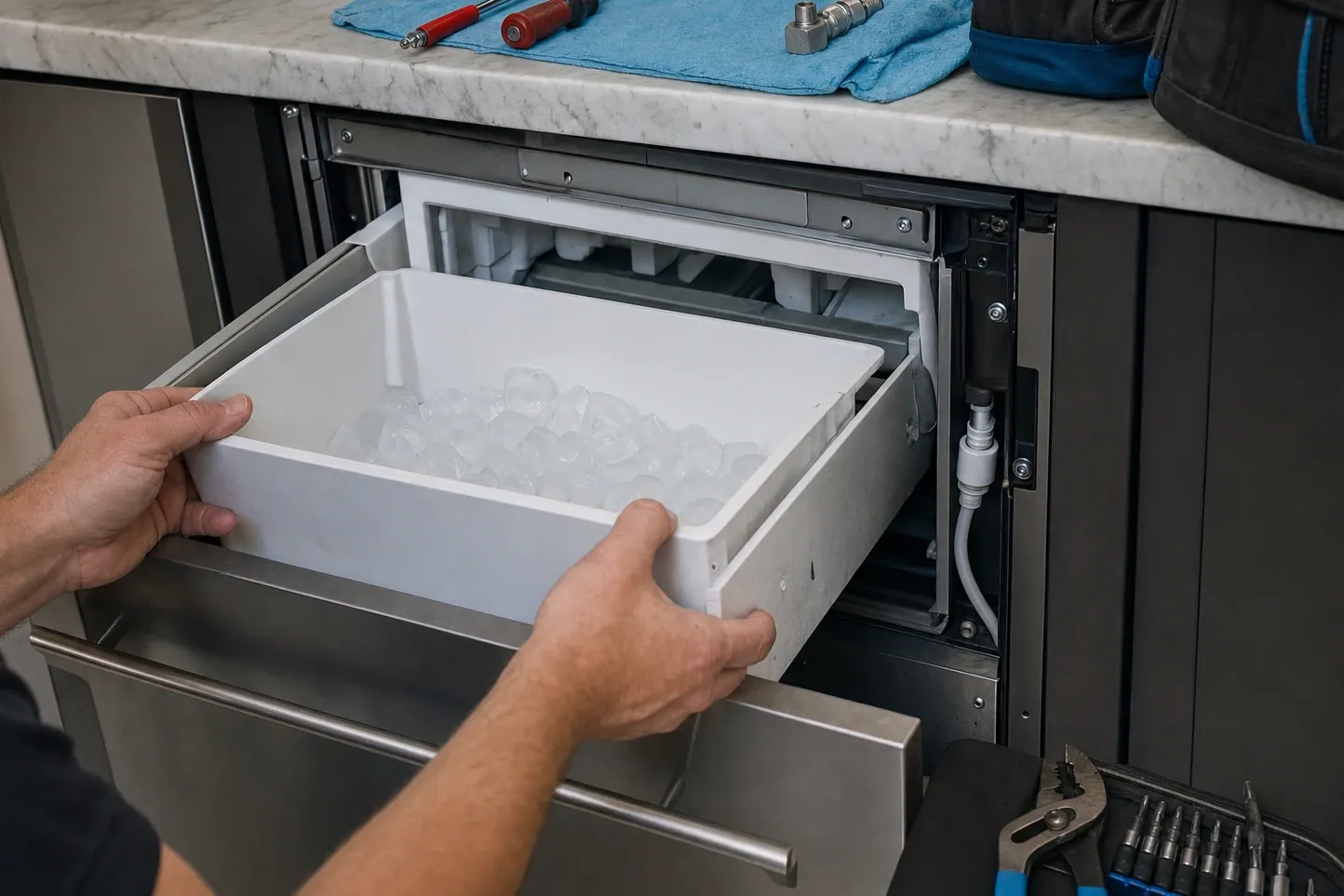
Cubes fuse when they stay in the bin longer than they were meant to. Each one carries a film of meltwater, the film refreezes against its neighbour, and a household that uses little ice ends up with a slab. Denver Sub-Zero Repair Experts looks at turnover first, then at a harvest that is arriving late.
Pattern
What we usually find
- Ice nobody uses. Two cubes a week is not enough movement to keep a bin loose, whatever the machine is doing upstream.
- A harvest arriving late, so a warm batch lands on cubes that have already begun to sweat.
- Door openings warming the top of the bin, after which a cold cycle sets the surface into a crust.
- A jammed cube holding the mould half full, which produces odd part-cubes that bind to everything around them.
Most often first. Order comes from what the visits keep turning up, not from a count.
The week-long test
Empty the bin completely, use ice normally for a week, then look again. A bin that stays loose has told you the machine is fine and the household is simply slow. A bin that welds itself back together in a few days is worth a call.
When the clump means more
A clump that forms while ice is being taken daily is a different animal. Something is putting water, or a warm batch, into the bin at the wrong moment, and that belongs to the harvest, the fill, or a mould releasing badly.
Before you call
Two minutes, before anyone comes out
- Break the slab up, empty the bin and start the week clean.
- Use the ice daily for a week and see whether it binds again.
- Check the bin is pushed fully home on its rails afterwards.
Stop there. If that has not settled it by the next morning, call Denver Sub-Zero Repair Experts on (720) 903-2603 and the rest of the water path gets traced with a meter.
When it needs somebody out: Ice Maker Repair in Denver.