Making the cube
Mould thermostat
The sensor that has to agree the cube is frozen before anything else in the cycle is allowed to happen.
- What it does
- It keeps the gate. Until the sensor clamped to the mould reports that the water has genuinely frozen, the heater stays off, the motor stays still and no fill is called for. On the heads Sub-Zero documents that sensor is a bimetal thermostat, closing at fifteen degrees Fahrenheit give or take three.
- Where it sits
- Against the ice mould under the head's cover, held so that it reads the metal rather than the air around it. It cannot be reached without taking the ice maker out, which is why this one gets diagnosed from behaviour long before anything is unbolted.
- How it is tested
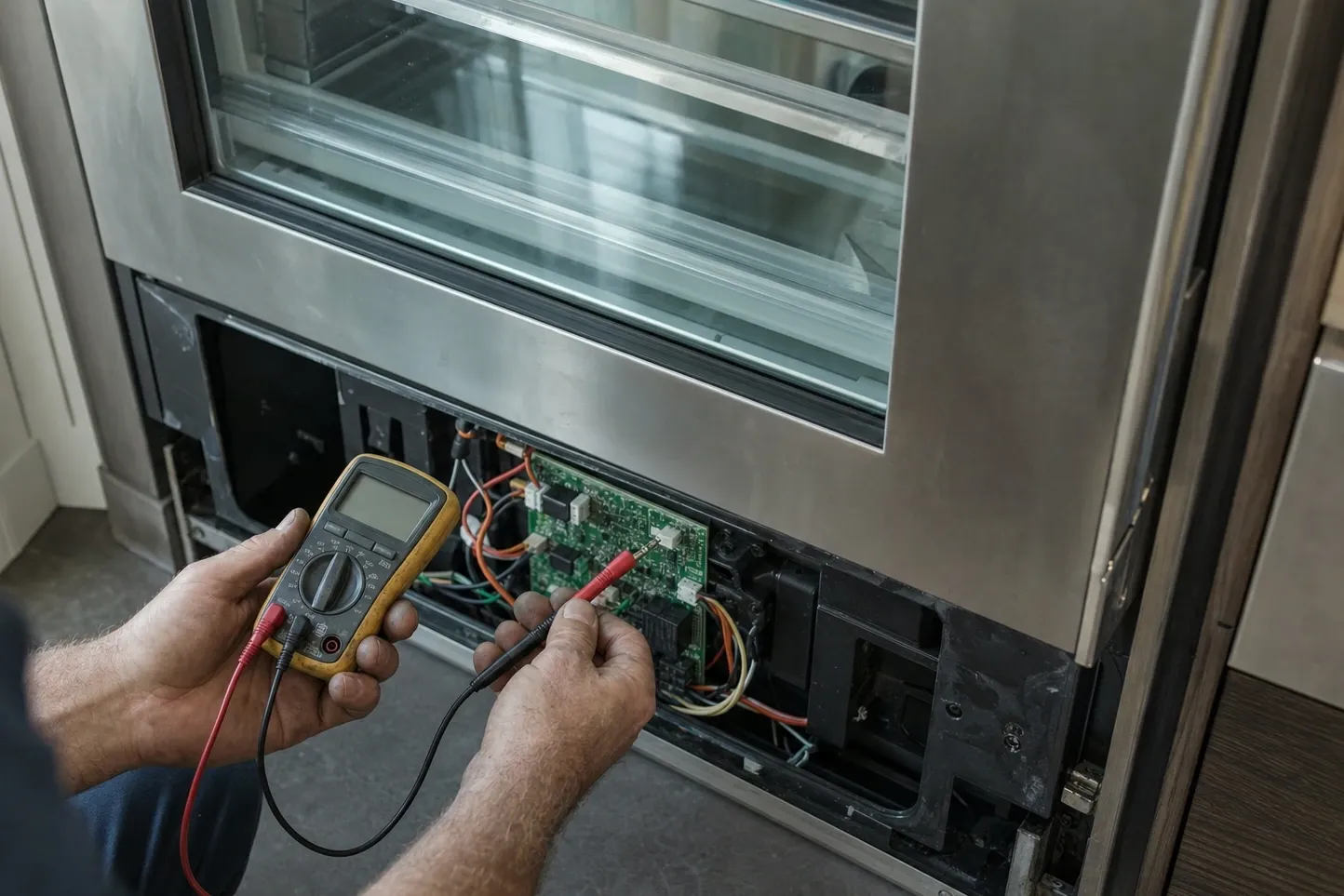
- From behaviour first: a machine that fills, freezes and then simply waits is pointing here. Then electrically, with the power off and the mould at a known temperature. A gate that never closes and a gate that closes early look nothing alike on a meter, and identical from the kitchen.
- What the work costs
- Ice maker, water valve or supply line: $300–$820, after the flat $89 diagnosis.
Pattern
What we usually find
- A gate closing late, so cubes overfreeze, weld to the tray and arrive as a slab rather than singly.
- Ice on some days and none on others, which is the classic look of a sensor sitting right on the edge of its threshold.
- A freezer running warmer than its setting, which starves the gate of the temperature it needs and is not a sensor fault at all.
- A sensor left reading air instead of metal after the head was last off, which stalls the harvest on an otherwise cold cabinet.
Most often first. Order comes from what the visits keep turning up, not from a count.
This is the part that turns a vague, intermittent complaint into something explainable. A gate of this kind rarely fails outright — it drifts, and a drifted gate opens on some days and not on others, which is very nearly word for word how the fault gets described on the phone.
That also decides where it comes in the order. Behaviour points here early; the meter only confirms it once the fill and the cabinet temperature have both come off the list.
Repair or replace
What usually happens to it
Replaced, and as part of the assembly rather than on its own. It is a sealed item whose calibration is the whole of its value, and there is nothing to adjust back into range. On a machine old enough for the gate to have drifted, the mould heater and the switches beside it are usually close behind.
Two follow-ups
Is this the same thing as a thermistor?
Not on the heads whose Sub-Zero service documentation we can read. Those use a bimetal thermostat, a snap contact that closes at a fixed temperature rather than a sensor reporting a value. Denver Sub-Zero Repair Experts confirms which is fitted on the visit instead of going by a model number.
Could the freezer temperature be the real problem here?
Often, and it is checked first. Sub-Zero asks for a freezer at or below five degrees Fahrenheit before ice production is judged at all, so a cabinet sitting above that will stall the cycle with a perfectly good sensor still clamped to the mould.