Making the cube
Ice mould and mould heater
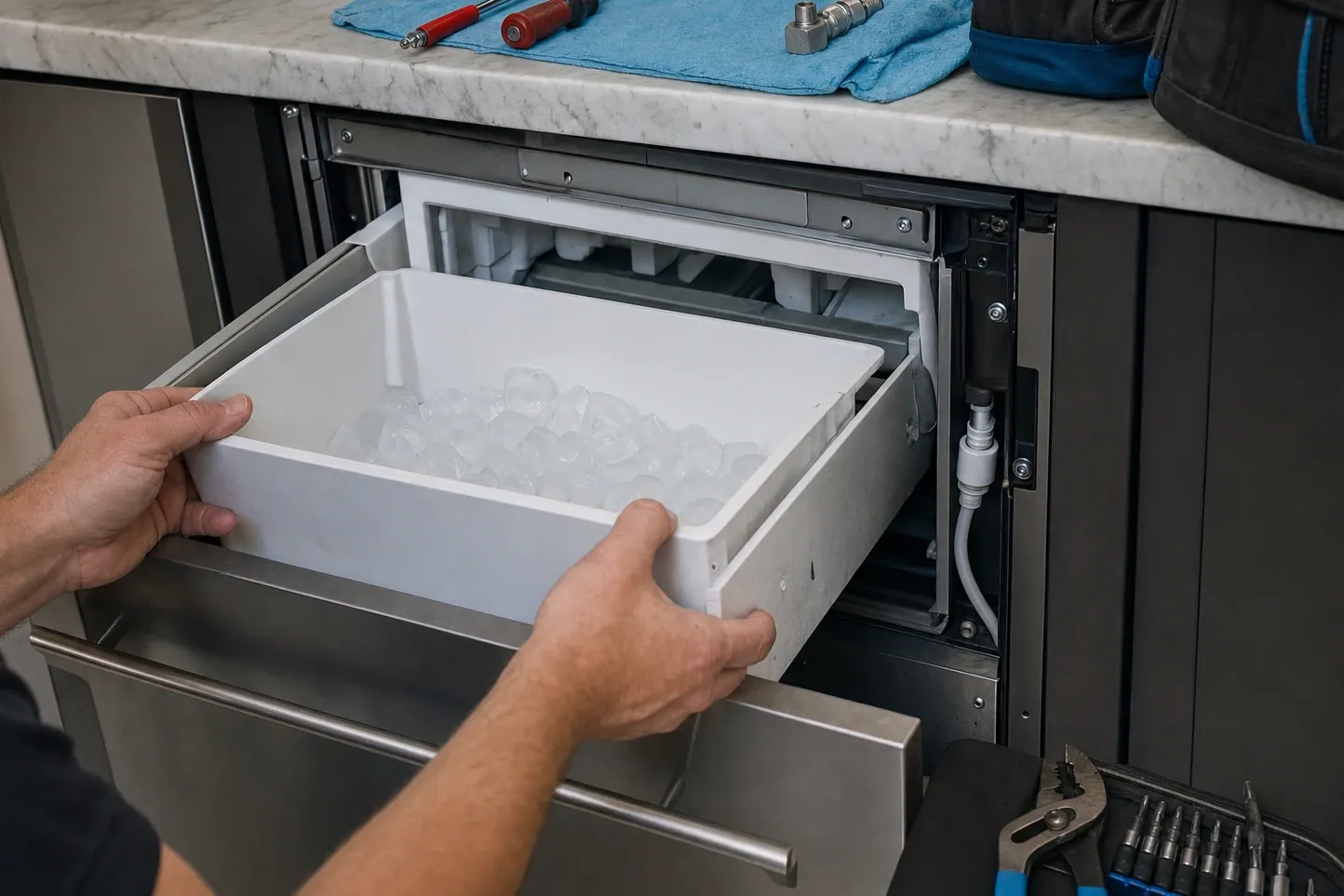
The tray the cube forms in, and the warmth that frees it again a few seconds before the ejector turns.
- What it does
- The mould is the metal tray the cubes freeze in; the heater is the element bonded beneath it. Ice will not slide off cold metal, so a short burst of warmth breaks the grip a moment before the ejector turns. Freeze, warm, release — and only then is the next fill called for.
- Where it sits
- Under the head inside the freezer compartment, with the element out of sight on the underside and the fill cup at one end. The mould belongs to the ice maker assembly rather than standing as a fitting of its own, and it comes away with it.
- How it is tested
- Cold, and largely by watching. A harvest is started and timed: a mould that warms and lets go cleanly is sound, and one that turns with the cubes still gripping it is not. Resistance across the heater circuit is read with the power off, once the sensor reporting mould temperature has been ruled in or out.
- What the work costs
- Ice maker, water valve or supply line: $300–$820, after the flat $89 diagnosis.
Pattern
What we usually find
- Mineral film across the tray from years of hard supply, which slows every release and makes a sound element look weak.
- A heater circuit gone open, so nothing lets go and the ejector labours against a tray that is still full.
- A mould still too cold at harvest because the sensor has drifted, which is a timing fault rather than a heat fault.
- Overfilled moulds welding a slab across the top of the tray, almost always from a fill that has started running long.
Most often first. Order comes from what the visits keep turning up, not from a count.
This pair is where two opposite jobs meet in one piece of metal. The tray has to take heat out of the water fast enough to make a cube, then put a little back in fast enough to lose it again, and both happen within the same revolution.
Scale is what undoes that balance. It insulates in one direction and grips in the other, so the first sign is rarely a dead machine — it is a harvest that takes longer and longer until a batch simply does not arrive.
Repair or replace
What usually happens to it
Replaced with the head on most assemblies, since the element is not a separate fitting here and a tray that has been scaled, prised at or overfilled for years goes with the module it belongs to. Surface scale is cleaned off first: a mould that releases properly afterwards has just told you the heat was never the problem.
Two follow-ups
Can the mould be descaled instead of replaced?
It is worth trying and it is the first thing done on the visit. A cleaned tray that releases properly for a fortnight has settled the question by itself. What cleaning cannot fix is a dead heater circuit or a distorted tray, and Denver Sub-Zero Repair Experts says which it is before quoting.
Why are the cubes cloudy if the mould is warmed every cycle?
That warmth is brief and touches only the surface that has to let go. Cloudiness comes from what is dissolved in the water rather than from anything the harvest does, so an element doing its job has no bearing at all on how clear a finished cube looks.