Making the cube
Shutoff arm and ice-level sensor
How the machine knows the bin is full — and the commonest reason a working ice maker stops for no reason.
- What it does
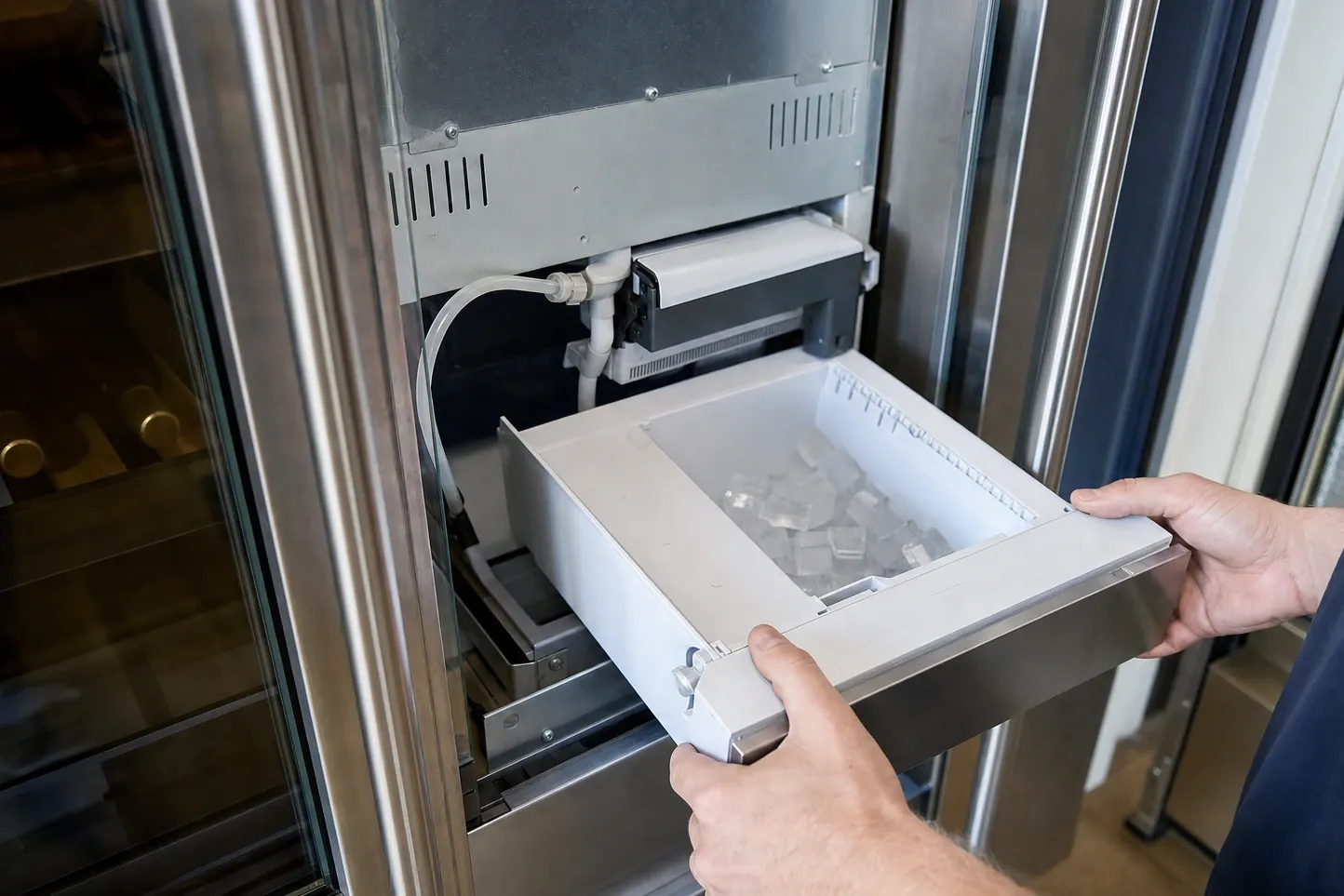
- It carries the stop signal. A wire arm rises and falls with every harvest, and if it comes down onto ice instead of into clear space the machine holds and waits. Sub-Zero also uses it as the manual switch: down is running, up is off, across roughly an inch of travel.
- Where it sits
- Along the side of the ice maker in the freezer compartment, swinging out over the bin beneath it. On some cabinets it works through a connecting rod to a separate level mechanism, so the arm you can see is not always where the movement ends.
- How it is tested
- By hand, then by cycle. The arm is lifted and lowered through its travel to confirm it swings freely and returns, the bin is checked for level and for rails pushed fully home, and a harvest is watched to see whether the arm drops into clear space or lands on a mound the machine built itself.
- What the work costs
- Ice maker, water valve or supply line: $300–$820, after the flat $89 diagnosis.
Pattern
What we usually find
- Ice heaped directly under the arm, holding it up and telling a perfectly healthy machine that there is nothing left to do.
- A bin not pushed fully home on its rails, which Sub-Zero asks owners to check before anything else is considered.
- An arm knocked out of line while the bin was pulled, so it either hangs short of the ice or catches on its way down.
- A connecting rod dislodged after the ice maker was last out, leaving the arm free to move and the signal never arriving.
Most often first. Order comes from what the visits keep turning up, not from a count.
Of everything in this section, this is the part most likely to be blamed for nothing and least likely to be at fault. It is a wire and a switch, and both outlast the machine around them.
What it does do is fake a full bin convincingly. Ice arriving in a heap rather than spreading out will hold the arm up weeks before the bin is anywhere near full, and from the kitchen that is indistinguishable from an ice maker that has quietly died.
Repair or replace
What usually happens to it
Rarely replaced. An arm is far more often obstructed, bent slightly out of its arc, or simply resting on ice piled up beneath it, and none of those three needs a part. The switch behind it belongs to the head, so a genuine electrical failure at this point is quoted as module work.
Two follow-ups
The arm is down and there is still no ice. What comes next?
Down is the running position, so the stop signal is not your fault here. Next come the bin sitting level on its rails, the freezer holding at or below five degrees Fahrenheit, and then the fill itself. Denver Sub-Zero Repair Experts works that order on every no-ice call.
Should I lift the arm if the house is empty for a month?
Yes, and shut the water off too if the valve is reachable. Leaving an ice maker live with nobody drawing from the bin is one of the ways a fill tube ends up frozen solid, and that is a longer visit than lifting a wire arm ever was.