From the house
Supply line to the unit
The run between the shutoff and the back of the cabinet, and the single most-searched fault on this site.
- What it does
- It carries house water the last few feet to the appliance, and it is the only part of the path that has to survive being pushed, pulled and folded every time the unit comes out for cleaning. Everything downstream of it is measured in seconds of fill; everything upstream is somebody else's pipework.
- Where it sits
- From the shut-off valve, along a wall or under a floor, and up behind the cabinet to a compression fitting at the unit. Sub-Zero's installation guidance asks for about three feet of slack left outside the wall so the connection can be made and the unit still rolled out afterwards.
- How it is tested
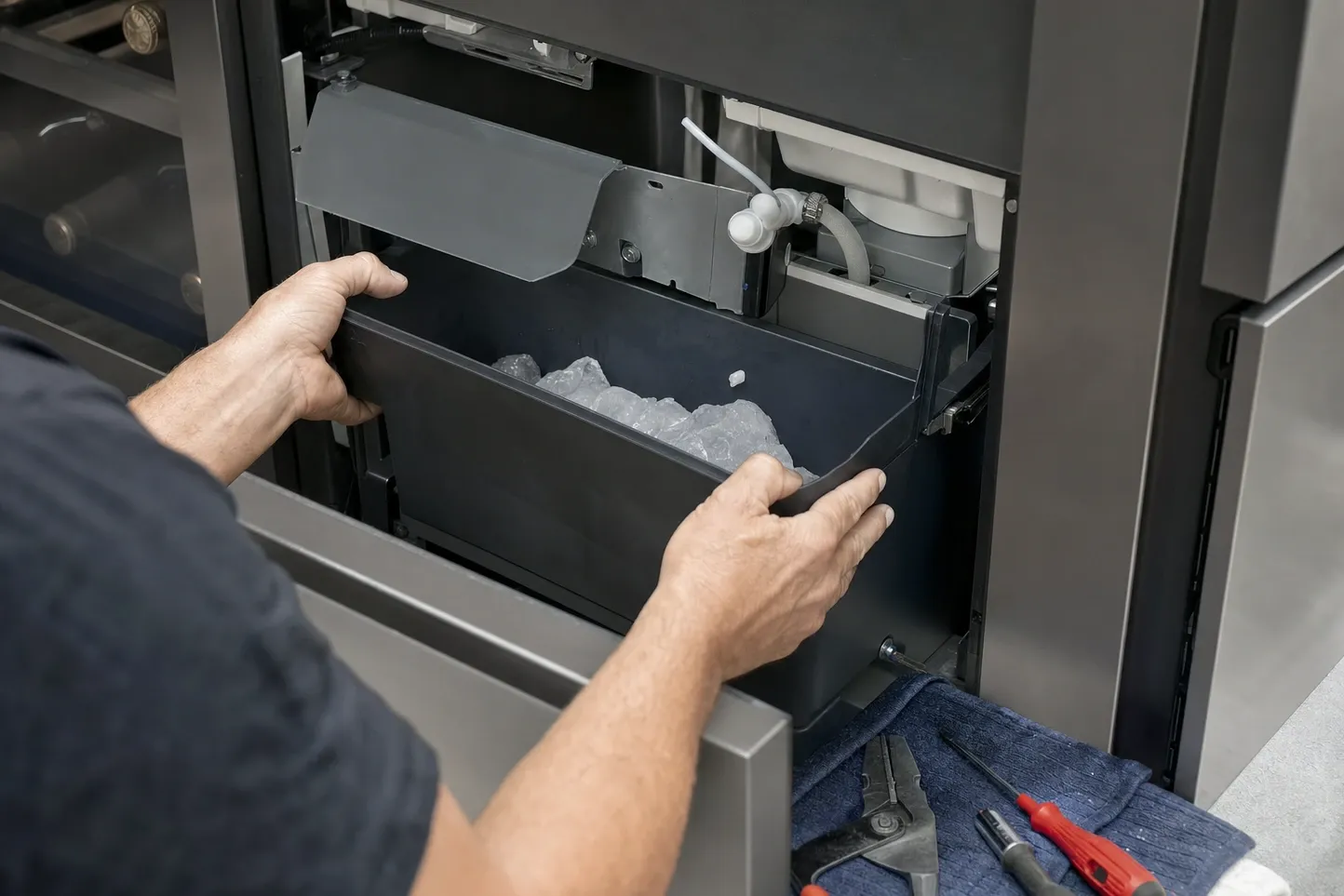
- Pressure and flow are read at the unit end, because a strong tap in the same room proves nothing about a line that has been flattened behind a cabinet. Then the run is looked at: the last foot where it turns up into the fitting, the coil of slack, and the fitting itself, dried and watched under a torch while the ice maker calls for water.
- What the work costs
- Ice maker, water valve or supply line: $300–$820, after the flat $89 diagnosis.
Pattern
What we usually find
- A kink a foot behind the cabinet, put there the last time the unit was pushed back. The fill shortens, the cubes shrink, and nothing inside the freezer is at fault.
- A compression nut that has loosened over years of vibration, dripping slowly onto the floor behind the unit where nobody looks until the cabinet base darkens.
- Copper fitted downstream of a reverse-osmosis system, which Sub-Zero warns against because the treated water leaches from the metal.
- A plastic line that has gone brittle beside a warm machine compartment and cracks the first time it is disturbed for a filter change or a clean.
Most often first. Order comes from what the visits keep turning up, not from a count.
This is the length of the water path that gets handled. A filter is changed in place, a valve is bolted down, a module never moves — the supply line is coiled, dragged and folded every time a built-in is rolled out.
So the search for a shrinking cube starts at the back of the cabinet rather than at the ice maker. A line that has been pinched once holds that shape, and a timed fill has no way to make up what a narrowed bore will not pass.
Repair or replace
What usually happens to it
A weeping compression fitting is remade; a line that is kinked, split or corroded is replaced as a whole run rather than patched in the middle, because a joint hidden behind a built-in is a leak waiting for a quiet weekend. Where the damaged length sits inside a wall or under a slab, the replacement belongs to a plumber and we say so before anything is opened.
Two follow-ups
Is the line part of the appliance or part of the house?
The compression fitting at the back of the cabinet is the boundary. Everything on the appliance side of it is ours; the run itself, the shut-off and the pipework feeding them belong to the house, which is why a leak there is often a plumber's call rather than a repair visit.
There is water on the floor now. What first?
Close the shut-off, then unplug or switch off the unit at the breaker, then mop and watch whether the puddle returns. Denver Sub-Zero Repair Experts would rather arrive to a dry floor and a known valve position than to a kitchen still filling.