From the house
Pressure regulator
The house device that decides whether the ice maker gets a steady fill or a different one every hour.
- What it does
- A pressure-reducing valve sits near where the water main enters and holds the whole house to a steadier figure than the street delivers. For an ice maker that matters more than it does for a shower: the fill is a fixed number of seconds, so the pressure behind it decides the size of the cube.
- Where it sits
- At the house end of everything on this page — on the main, often close to the meter or where the service enters a basement or crawlspace. Nothing about it is inside the kitchen, and nothing about it is inside the Sub-Zero.
- How it is tested
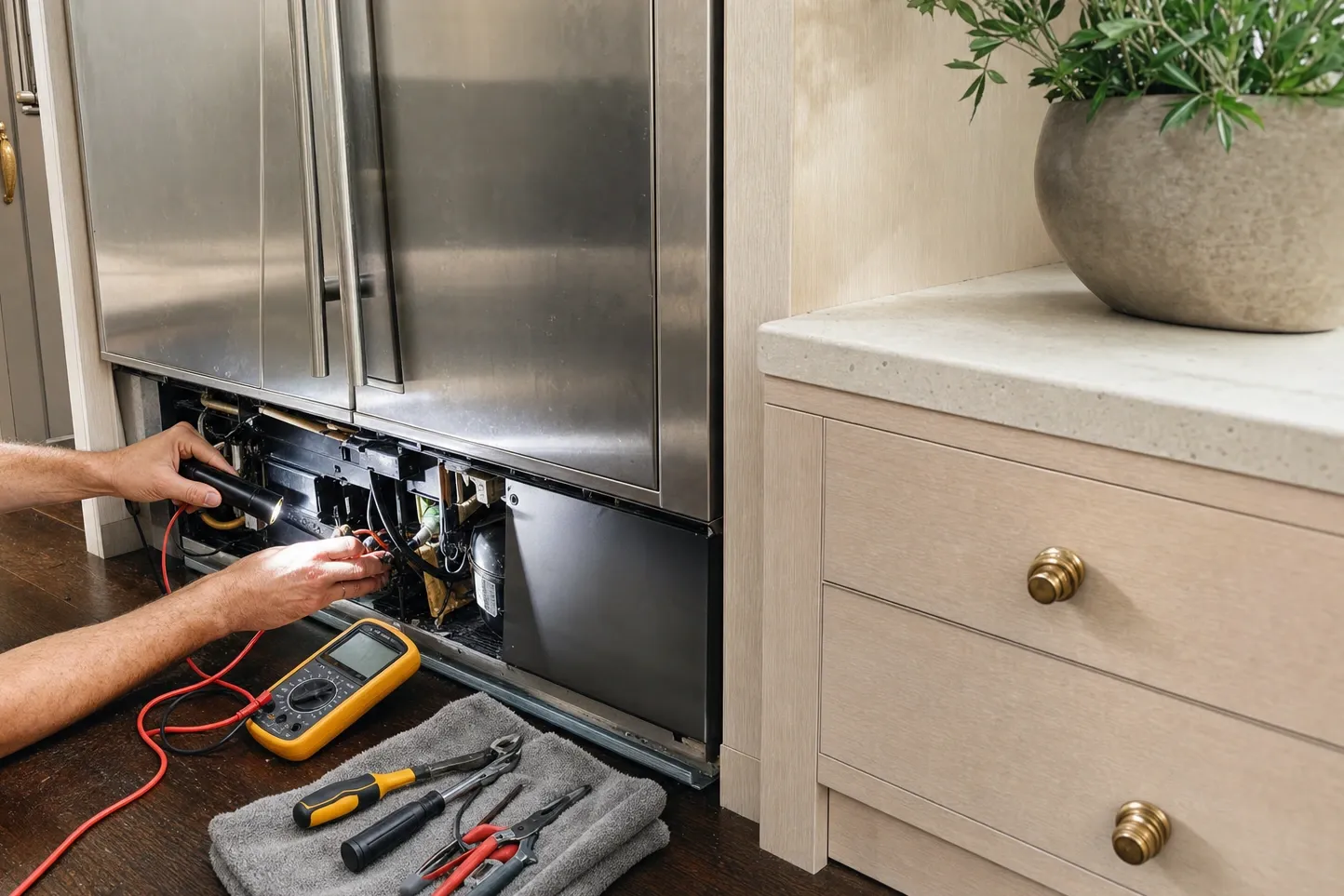
- Only at the appliance. Sub-Zero publishes two model-dependent windows — 20 to 100 psi, or 35 to 120 psi — and says plainly that it supplies no tool or procedure for confirming pressure, referring owners to a plumber. So we read what arrives at the unit, morning and again under load, and compare that reading with the window the model actually wants.
- What the work costs
- A house regulator is a plumber's fitting. We measure what arrives at the unit and say what it needs.
Pattern
What we usually find
- Pressure that sits inside the window at eight in the morning and falls out of it when irrigation, laundry and a second bathroom all run at once.
- A regulator set years ago for a different fixture list, now holding the house below what the newer built-in was specified to run on.
- A reverse-osmosis system between the main and the unit, dropping the delivered pressure under the floor of the range Sub-Zero quotes for ice production.
- A regulator working perfectly, with the loss further down: a part-closed shut-off, a furred inlet screen or a flattened line, all of which read the same from the bin.
Most often first. Order comes from what the visits keep turning up, not from a count.
Pressure is the one thing on this page that changes by the hour, which is why it is so often missed. A morning reading and an evening reading can sit on opposite sides of the model’s window, and the ice maker will cheerfully make good cubes for one of them.
That is also why a regulator is worth naming as a component at all. It is not a Sub-Zero part and it will never appear on a parts list, but it decides what the inlet valve has to work with, and no amount of work inside the cabinet can add pressure that never arrived.
Repair or replace
What usually happens to it
Nobody adjusts or replaces it on an appliance visit. A regulator that has drifted low, stuck, or was set for a house that has since been re-plumbed is a plumbing fitting with a plumbing fix, and the same is true of a booster where a reverse-osmosis system has taken the pressure down. What we can do is settle the argument with a reading.
Two follow-ups
Does every house have a pressure regulator?
No. It is fitted where incoming pressure runs high enough to need holding back, so some homes have one and some do not. Its absence is not a fault, and its presence is not a diagnosis — what matters is the figure the appliance actually sees.
Will a booster fix small cubes?
Sometimes, and only when a reading says the supply is genuinely short. Sub-Zero suggests a booster or regulator where pressure is inconsistent or too low, and points the owner at a plumber or the water-treatment supplier. Denver Sub-Zero Repair Experts measures first so nobody buys one on a hunch.