From the house
Shutoff valve and saddle valve
The tap that isolates the appliance, and the fitting that took the water off the house pipe in the first place.
- What it does
- It is the hand tap between the house plumbing and the appliance, and the only way to stop water reaching the unit without turning off the whole kitchen. Sub-Zero builds no shut-off into the cabinet itself, so whatever a plumber fitted on the line is the entire isolation the machine has.
- Where it sits
- Sub-Zero asks for it somewhere a homeowner can actually reach — an adjacent cabinet, under a nearby sink, or down in the basement. In practice it often ends up behind the kickplate, roughly six inches back from the compression fitting where the line meets the unit.
- How it is tested
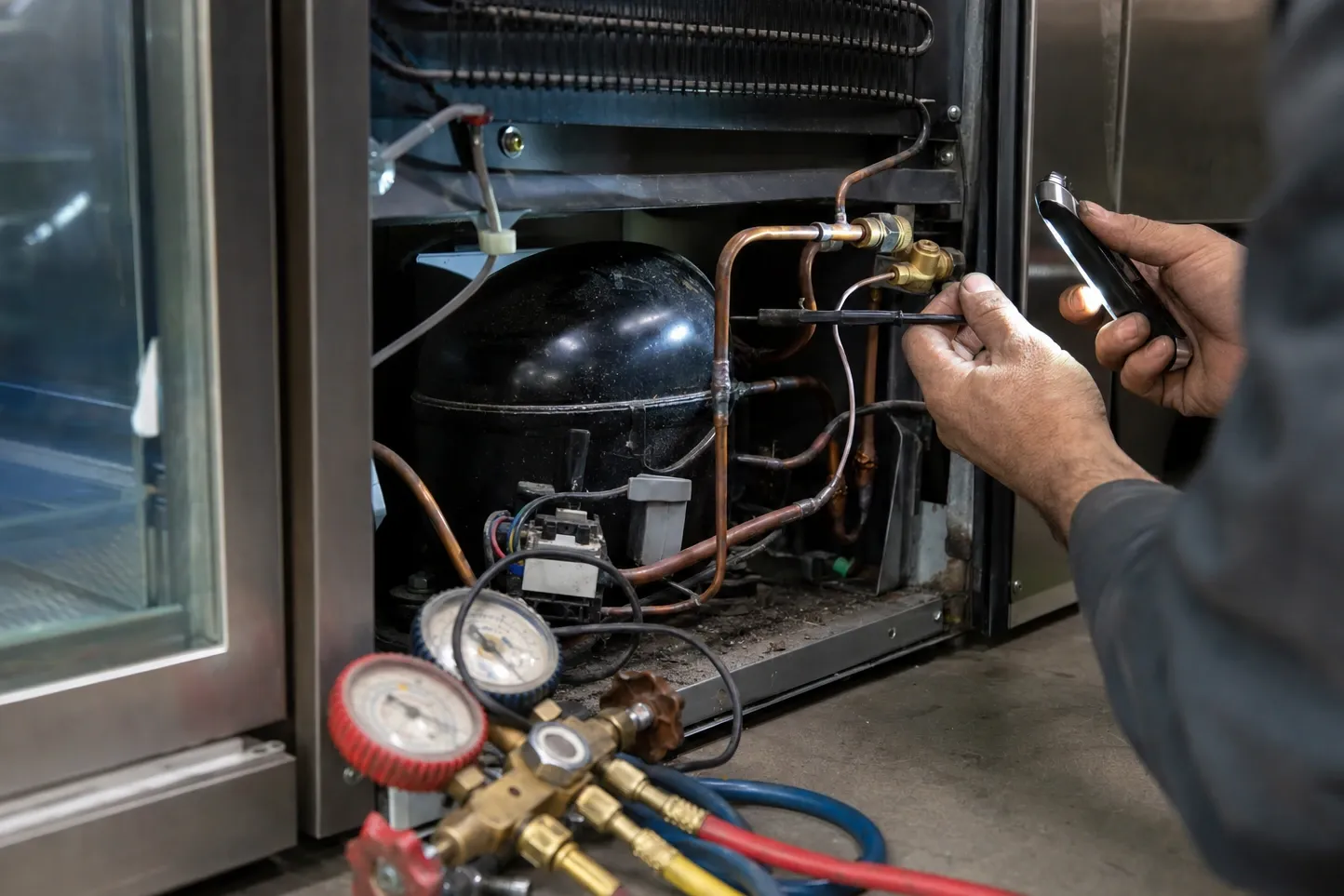
- Not by turning it — a valve that has sat open for years can seize or start weeping the moment it is moved. We look first, for a green crust at the stem or a dried mineral trail down the pipe, then read the pressure at the fitting where the line leaves the valve rather than at a tap on the other side of the house.
- What the work costs
- Work on the house side of the fitting belongs to a plumber. What we price is the appliance side.
Pattern
What we usually find
- A saddle valve still in service on a bungalow's copper, pinching the supply down to a trickle that the ice maker's timed fill can never make up.
- A shut-off nobody has closed since the unit went in, seized part-open, so the line is throttled without anything looking wrong from the kitchen.
- A valve weeping at the stem rather than the outlet, which dries to a white ring and gets mistaken for a leak from the appliance behind it.
- No reachable valve anywhere — the isolation is a whole-house stop in a crawlspace, which turns a quick cartridge change into an afternoon.
Most often first. Order comes from what the visits keep turning up, not from a count.
Two valves get confused on the same line, and they are not the same thing. One is the tap a plumber fitted so the appliance can be isolated; the other is the clamp that took the water off the house pipe in the first place.
Sub-Zero’s position on the second is unambiguous: self-piercing valves will not supply enough water flow to be effective. A kitchen reads that as thin cubes, then as a bin that never fills, and almost never as a plumbing fault at all.
Repair or replace
What usually happens to it
Replacement is a plumber's job, and we say so on the visit rather than after it. A self-piercing saddle valve is not a repair item at all: Sub-Zero rules the type out because it will not pass enough water, so the honest outcome is a valve cut into the pipe instead of clamped onto it. Our work starts at the compression fitting.
Two follow-ups
How do I know whether mine is a saddle valve?
Look where the line taps the house pipe. A saddle valve is a small clamp wrapped around an otherwise unbroken pipe, usually with a knurled handle on top. A proper valve interrupts the pipe, with a fitting on each side. Neither needs touching to be identified.
Can you replace the shut-off while you are here?
No — pipework on the house side of the compression fitting is a plumber's trade, and Denver Sub-Zero Repair Experts will not pretend otherwise. What we do is measure what actually reaches the unit and put that figure in writing, so the plumber starts from a reading rather than a description.