Refrigerator Repair
Sub-Zero Display Panel Symbols: What Each Icon and Code Means
Sub-Zero refrigerator display panel symbols fall into three groups: everyday status icons, settings that only look like faults, and real warnings such as EE, EC40 and EC50 that need a technician. Here is how to read each one and what to do next.
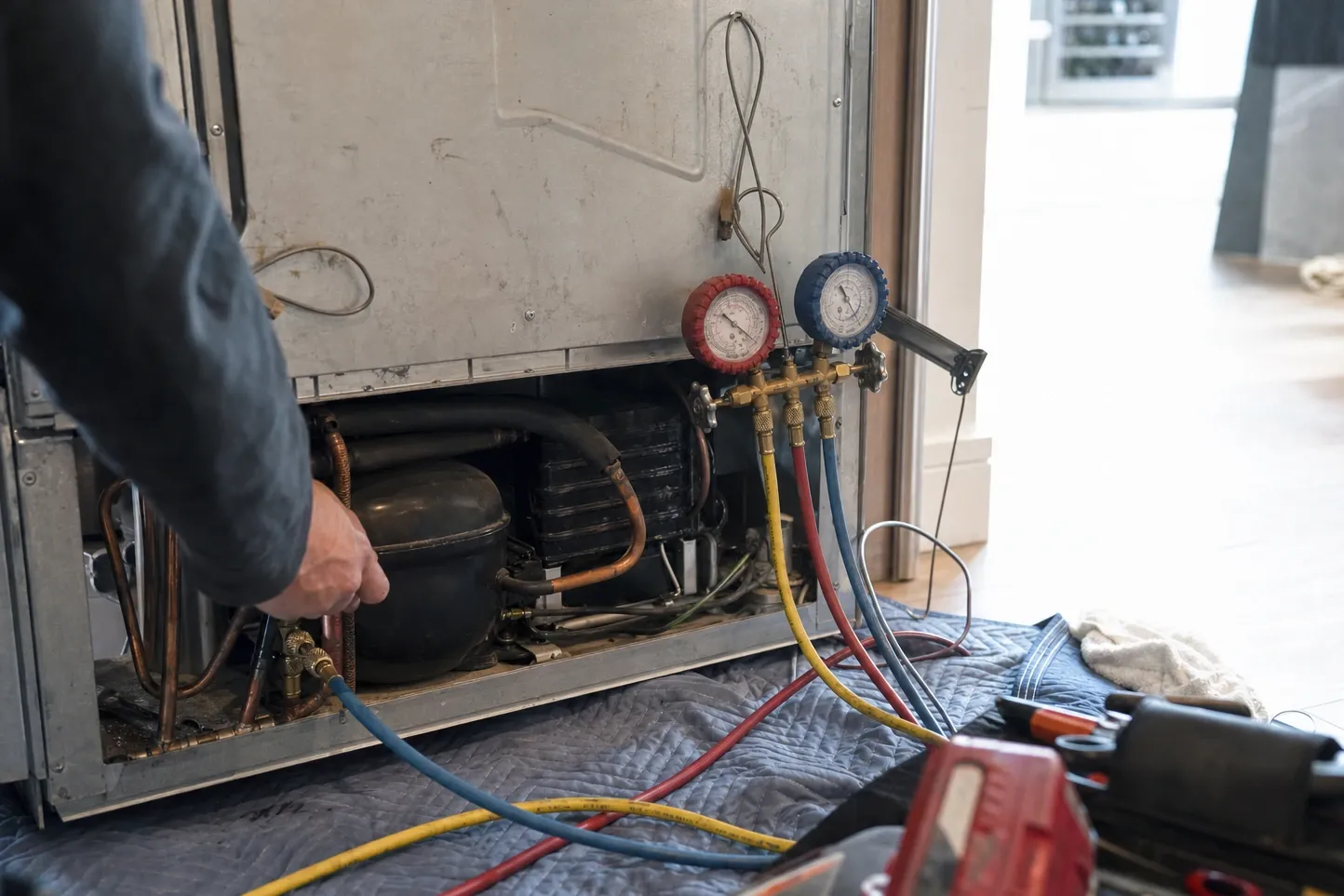
Sub-Zero refrigerator display panel symbols come in three kinds. Some are everyday status icons: the two zone temperatures, the ice maker symbol, the filter reminder. Some are settings that only look like faults, such as Showroom Mode or a pair of dashes. The rest are true warnings, shown as a flashing Service light, a wrench, or a code like EE, EC40 or EC50. The first kind needs nothing from you, the second can usually be undone at the keypad, and the third is the panel asking for a diagnosis. Denver’s semi-arid air carries plenty of fine dust, and a built-in pulls room air across its condenser all day, so here the condenser deserves a look before any code gets blamed on the electronics.
What the display panel actually does
The panel is the face of the whole control system. Small sensors called thermistors sit in each compartment and report temperature; the control board compares those readings with your set points and switches the compressor, fans, lights and ice maker to match. The keypad is how you talk to that board, and the symbols are how it answers. Because Sub-Zero cools the fresh-food and freezer sections with separate systems, the panel reports each zone on its own, and many codes point at one side or the other.
The panel can fail as well. A worn keypad stops answering presses, segments of the digits go dark, or the screen stays blank while the unit keeps humming. Those symptoms belong to the control electronics, not the cooling, and they are a technician job; replacing an electronic control board typically runs $450–$930 once the fault is confirmed.
Status symbols that need nothing from you
The two temperature readouts are simply your set points. The ice maker symbol tells you whether ice production is switched on, and if you are unsure how to toggle it, see how to switch a Sub-Zero ice maker on or off. A filter reminder means the cartridge is at the end of its service life, not that something broke. On a Classic (CL), raise the grille from the bottom, twist the spent filter a quarter turn to the left to free it, uncap the replacement, push it home with a twist to the right, and let the panel’s prompts finish the job. You can also read whether it is safe to run a Sub-Zero without a filter for a few days.
Dark interior lamps fool a lot of people. Classic (CL) and Designer (DET, DEC) controls kill the lights whenever a door or drawer has not fully latched, purely to keep their warmth away from the food. Close everything properly and wait an hour before assuming a fault.
Settings that look like faults
Showroom Mode is the demonstration setting dealers use on a sales floor: the panel glows and looks normal, yet the cooling never runs. On a current Classic or Designer unit the giveaway is 38° and 0° on the display while the cabinet is warm, and Sub-Zero’s advice is to ring its customer care line. A Classic (BI) shows Sh r instead, and the owner can undo it. Turn Power off, keep one Warmer key and its matching Colder key held down, tap Power, and release the lot.
Two dashes in place of a temperature mean that zone was switched off, often by a stray press while wiping the glass. On a Classic (BI) and the later built-in lines, shut the unit down with Power, then keep that zone’s Warmer key down as you press Power once more.
| What you see | What it means | Who deals with it |
|---|---|---|
| 38° and 0°, cabinet warm | Showroom Mode on a current unit | Sub-Zero customer care |
| Sh r | Showroom Mode on a Classic (BI) | You, at the keypad |
| Two dashes | That zone is switched off | You, at the keypad |
| Steady wrench with chime | Minor fault, food temperatures safe | Book a visit soon |
| Flashing wrench or Service | Major fault logged | A technician |
| EE | Failed temperature sensor | A technician |
| EC40 or EC50 | Compressor running too long | Check the condenser, then call |
Warnings: the wrench, Service and the EE and EC codes
On a Legacy Classic (BI) the wrench has two speeds. Flashing with a chime means the control logged a major error; lit steadily with a chime, it marks a minor fault that is not putting food temperatures at risk. Newer units pair a flashing Service light with a code instead.
EE next to Service, or next to a flashing wrench on a Classic (BI), means a thermistor has died, and the side tells you which: left is the freezer sensor, right is the refrigerator sensor. Sub-Zero offers owners no steps for this code, so it goes straight to a technician, and sensor replacement generally falls between $300–$600.
EC40 with Service flashing, seen on the 648PRO and similar built-ins, says the freezer compressor is running far too long. The trigger might be nothing worse than a door not quite shut, or it might be a fan, a temperature sensor or the sealed system. A freezer sitting under 10° above its setting calls for a condenser cleaning first. Once it is more than 10° over with every door properly closed, Sub-Zero wants service booked, and the code left alone for as long as the reading keeps rising.
EC50 is the refrigerator-side twin. If the fresh-food side is holding near its setting, vacuum the condenser, then keep the bell key, which is the door-ajar alarm button, pressed for 15 seconds to wipe the code. A warm cabinet means a call instead. On a Classic (BI), a constant chime can be hushed by holding ALARM and POWER together and letting go in under 5 seconds; that hides the indicator for 24 hours and repairs nothing.
Check the thermometer before the condenser
Leave an appliance thermometer on a middle shelf for a few hours. Sub-Zero notes that a refrigerator above 48 degrees while set to 38 is unlikely to recover from a condenser cleaning alone, so at that point skip the brush. A unit less than 6 months old does not need the cleaning either, so a code that early points elsewhere.
Where the condenser lives depends on the series: behind the grille that lifts up on a Classic (CL), behind a kickplate fixed with a pair of screws on a Designer (DET, DEC). Power the unit down from its own panel first, wear gloves, and run the vacuum’s soft brush along the fins, never across them.
DIY or a technician job?
You can close doors, swap a filter, leave Showroom Mode on a Classic (BI), revive a dashed-out zone, clean the condenser and clear an EC50 once temperatures recover. The rest of the warning list is technician work, partly for safety: current Sub-Zero guides say these appliances hold a flammable refrigerant that only specially trained technicians may service, so sealed-system repair, typically $1,410–$3,070, is never a weekend project. A failed evaporator or condenser fan motor usually lands at $350–$670.
We work in LoDo, Central Park, Congress Park and Berkeley, and the Berkeley service page has local details. Every visit starts with an $89 diagnosis, one flat fee however long the hunt takes, credited toward the repair if you approve it; the firm repair price comes after the cause is known. Call (720) 903-2603 or use the booking button on this page, and have the symbol or code you saw ready.
Follow-ups
Why does my Sub-Zero display read 38 and 0 when nothing is cold?
The unit is probably in Showroom Mode, a sales-floor setting that keeps the display lit while the cooling stays off. On current Classic and Designer models Sub-Zero asks owners to call its customer care line, while a Legacy Classic (BI) shows Sh r instead and can be returned to normal from its own keypad.
Can I clear a Sub-Zero error code on my own?
Only the milder ones. An EC50 can be cleared by holding the bell key for 15 seconds once the condenser is clean and temperatures are near normal. An EE code has no owner fix at all, and an EC40 should never be cleared while the freezer keeps getting warmer.
Does silencing the alarm fix the fault?
No, it only hides it. Holding ALARM and POWER together on a Classic (BI) and letting go in under 5 seconds hides the indicator for 24 hours, but the malfunction is still there and the warning returns if nobody repairs it.
How is a Sub-Zero display different from a regular fridge's?
It reports the refrigerator and freezer separately, because a Sub-Zero cools each side with its own system, which is why codes such as EC40 and EC50 name one compartment. A typical freestanding fridge shares one cooling loop between both sections and its panel tells you much less.
What does a diagnosis cost if my panel shows a code?
Diagnosis is a flat $89, however long the search for the fault takes, and that amount comes off the repair if you approve it. The repair itself is quoted firmly once the technician knows the cause, since a sensor, a fan and a control board each cost very different amounts.