Ice Maker Repair
Why Your Sub-Zero Ice Cubes Have Floaties
Ice cube floaties are usually minerals from your tap water that freezing crowds into the core of each cube and releases as white flakes when it melts. Here is how an ice maker causes that, and when the bits are not harmless.
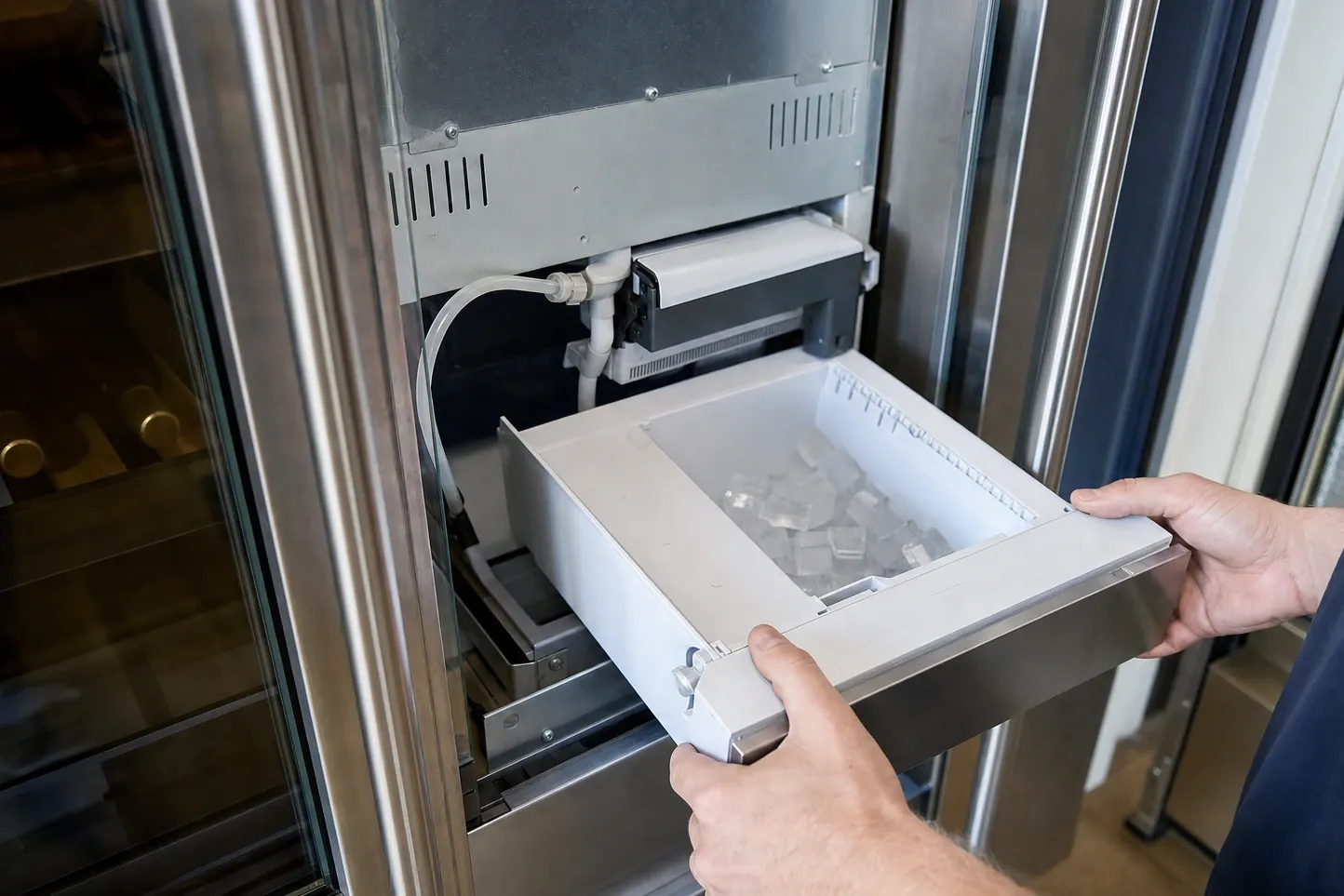
Those floaties are almost always minerals that were already dissolved in your tap water. Freezing works like a sorting machine: as a cube hardens from the outside in, pure water locks into crystal while calcium, magnesium and trapped air get pushed into the shrinking pocket of liquid at the core. By the time that core turns solid, the minerals are too crowded to stay dissolved, so they set as tiny specks. Drop the cube in a glass and, as it melts, those specks drift loose as white flakes. They are harmless, and on their own they say nothing bad about a Sub-Zero or any other freezer. Black grit, pink slime or hard slivers are another matter, and each one is covered below.
What happens inside the ice maker between fills
A freezer ice maker repeats one short routine all day. A water valve opens briefly and sends a measured shot of water down a fill tube into the mold. Cold air freezes it solid, a short warm-up loosens the cubes, and an ejector sweeps them into the bin. A bail arm or sensor halts the routine once the bin is full.
Sub-Zero’s in-door ice makers drop roughly 8 cubes, about 4.6 oz of ice, on each harvest, repeating every 2 to 3 hours for 64 to 96 cubes a day. An emptied bin can need 2 days to refill, so the cubes at the bottom of a quiet household’s bin may be weeks old.
Why freezing pushes minerals into the middle of a cube
Ice crystals are fussy. Water molecules lock into a neat six-sided pattern, and dissolved minerals and air bubbles have no place in it, so the freezing front keeps shoving them ahead into whatever liquid is left. In a mold the cold arrives from several sides at once, so the last liquid sits near the center. That is the cloudy white heart of an ordinary cube, and it is where the minerals end up packed tightest.
Once they pass the amount water can hold, calcium carbonate and its relatives drop out of solution as solid grains. Melting sets those grains free far faster than they can dissolve again, which is why the flakes linger in the glass and drift to the bottom.
Denver water and the filter question
Denver’s tap water begins as mountain snowmelt, and its mineral load can shift with the source and the season, so a household in Congress Park or Berkeley may see floaties come and go with nothing changed in the kitchen. A standard carbon filter does not help much here: it targets chlorine taste and sediment, not dissolved hardness.
Plenty of Sub-Zero equipment has no built-in filter to blame: the 500, 600 and 700 Series, the UC-24, ID drawers, DEU undercounter units, and every wine unit save the IW-30CI. The DEU1550I ice maker does not come with one either. There, the cube holds whatever the house supply delivers; our guide to ice output and Denver’s water covers that supply.
Reading the bits in your glass
Not every floater is a mineral. What you see points at the source:
| What you see | Likely source | First step |
|---|---|---|
| White flakes as it melts | Hardness minerals | Nothing urgent |
| Fine black grains | Carbon dust from a new filter | Run off several glasses |
| Pink, green or black film | Biofilm or mold | Wash the bin |
| Hard plastic slivers | A cracked ice maker part | Stop using the ice |
| Reddish-brown grit | Corroded line or fitting | Check the water path |
In a newly finished Central Park home, the first bins after move-in can carry grit flushed loose from new plumbing; it usually clears within a few cycles.
Getting rid of mineral floaties
The one kind of filtration that pulls most dissolved minerals out of water is reverse osmosis. Sub-Zero says an RO system may feed its units as long as the pressure holds steady between 35 - 120 psi, any internal push-in or twist-in filter is bypassed, and no copper line runs after the RO unit, because water stripped that clean tends to attack copper. Our answer on running a Sub-Zero from reverse-osmosis water walks through the setup.
Two popular shortcuts disappoint. Boiling tap water first drives out some air, so a homemade cube may look a little clearer, but every grain of calcium stays put. A fresh carbon cartridge improves taste, yet the flakes keep coming because dissolved hardness slips straight through carbon.
Clear-ice machines solve it a different way
For glass-clear ice, a dedicated undercounter machine is the tool. Instead of freezing a still pool in a mold, a unit like the UC-15I keeps water moving across a chilled surface so ice builds in thin layers while air and many minerals stay in the flowing water. Flushing that water away helps explain why the UC-15I uses about 1 gallon of water an hour, or 24 gallons a day, while making up to 50 lb of ice daily and storing up to 25 lb.
The weak point is drainage. On gravity-drain undercounter models, the drain fitting and any slack tubing must stay within 7 inches (178 mm), measured up from the feet of the leveling legs. Standing water breeds slime, so check whether yours needs a drain pump.
When floaties point to the bin, not the water
Cubes that sit for weeks shrink slowly as dry, moving freezer air pulls moisture off them, and their roughened surfaces pick up whatever is in that air. Sub-Zero’s Dual Refrigeration runs separate refrigerator and freezer systems, which is meant to keep fresh-food odors away from frozen food and ice, but no design can stop a film from growing in a bin that never gets emptied.
If the floaters look slimy or the ice tastes stale, clean the bin properly. Switch the ice maker off, tip out every cube, and scrub the bin by hand using lukewarm water and a drop of gentle soap. Once it is rinsed and bone dry, slide it back, restart the ice maker and discard the first harvest.
When the ice maker itself needs a look
Some signs mean the machine, not the water, is shedding material. Hard plastic slivers suggest a cracked mold or a worn ejector. Slime that returns within weeks of a thorough clean usually means growth you cannot reach, such as in the fill tube or chute. Reddish grit points back along the supply line. Floaties alongside small or hollow cubes hint that the fill is running short.
Our diagnosis is a flat $89 however long the search takes, and that sum is subtracted when you go ahead. Fixes to the ice maker, its inlet valve or the feed line typically sit in a $300–$820 band, firmed up once the fault is known. Reach Denver Sub-Zero Repair Experts at (720) 903-2603 or through this page’s booking button.
Follow-ups
Are the white flakes in melted ice safe to drink?
Yes, white flakes that appear as ice melts are normally the same calcium and magnesium you swallow in every glass of tap water; freezing simply crowds them together until they become visible. Treat it differently if the bits are black, slimy, pink or hard like plastic, because those come from a filter, the bin or a worn part rather than from the water itself.
Is it a good sign if ice floats, and what if a cube sinks?
Floating is ordinary physics and tells you nothing about how clean the ice is. Water swells by about 9 percent as it freezes, so a cube is lighter than the water around it and always bobs at the top of a plain glass. A cube only sinks in a liquid lighter than ice, such as very high-proof alcohol.
How can I make crystal clear ice at home?
Use low-mineral water and freeze it slowly from one direction. Reverse-osmosis or distilled water removes most of what clouds a cube, and freezing in an insulated container with the lid off drives trapped air downward so the cloudy bottom can be trimmed away. Boiling the water first helps only a little. An undercounter clear-ice machine such as the UC-15I handles all of this for you.
What do moldy ice cubes look like?
Contaminated ice usually carries pink, orange, green or black specks or a slippery film, most often on the cube surfaces, the bin walls or the chute, and it tends to smell or taste musty. Mineral flakes, by contrast, are white, gritty and only show up once the cube melts. Wash the bin first; if the film comes back quickly, the ice maker needs a closer look.
How do I reset a Sub-Zero ice maker?
Start by switching the ice maker off and on again at the control; on many Sub-Zero built-ins one ice cube icon means it is on and three mean Max Ice is running. If the display shows error 30 8 05, meaning no fill signal, Sub-Zero advises confirming the freezer sits at or below 0°F, freeing any cubes stuck in the mold, then turning the breaker off for 30 seconds.